Driven from her home by gang violence, Eugénie Laventure now lives in the KID displacement camp in Port-au-Prince with her four children. | © T. Noreille / HI
My name is Eugénie Laventure, I am 42 years old and I have four children whom I look after on my own. I used to live in Solino, a neighbourhood in Port-au-Prince. I wouldn’t say everything was perfect, but I had a shop, a house, and I was getting by.
When the war broke out, the bandits set fire to and burned down my shop, my house, and everything I owned. Since that day, I’ve been unable to do anything.
After the attack, we even slept on the streets for a while. It was a friend who told me about the KID camp for displaced people where we live today. We moved there in November 2025.
 Life here is hard, very hard. We’re not living well: we live in a tiny space and, as we had to leave almost all our belongings behind when we fled our home, we have almost nothing left. Here, there are only a few toilets for hundreds of people and it’s hard to find food.
Sometimes, my children are mistreated by people with bad intentions: not long ago, one of my sons was violently slapped and couldn’t defend himself. As I’m no longer working, I can’t afford to pay for school or university to allow them to continue their studies.
None of this would have happened if we were still at home. Nothing would have happened without that outbreak of violence that forced us to leave.
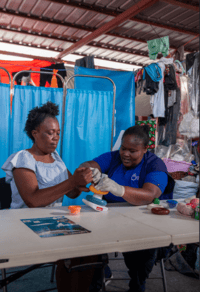
When I arrived at this centre, I met Gaëlle and Mario, the physiotherapists at HI. I had a stroke a few years ago and, since then, I had lost the use of the left side of my body: I couldn’t walk, get up or wash myself, or go to the toilet on my own.
Thanks to the therapy sessions with Gaëlle and Mario and the exercises they had me do, I have made great progress: I walk without crutches, I can open my hand and make small movements. Everything that was impossible for me before, such as washing myself, is now possible. It’s a real change and a real relief!
I am very grateful to HI; may God always protect Gaëlle and Mario in their work, at home and on the road. Now, I dream of being able to open a shop again, so that I can help my children.
The Post-Traumatic Rehabilitation Emergency (URPOST) project is being rolled out across five sites for displaced people in Port-au-Prince. Its aim is to improve access to care and rehabilitation support for patients, to reduce suffering and the side effects of injuries and prevent any form of long-term disability, as well as to reduce trauma-related sequelae for survivors of gender-based and sexual violence. Launched in August 2024, the project has already supported more than 1,500 patients in rehabilitation, 152 of whom received mobility aids (crutches, walking sticks, wheelchairs, etc.). In addition, 95 survivors of violence have benefited from protection services and 41 dignity kits have been distributed. HI has also delivered training for other humanitarian actors to encourage the inclusion of women and girls with disabilities in the responses provided.