School destroyed by a rocket strike, Kharkiv region. | © L. Hutsul / HI
For four years, civilians have been subjected to indiscriminate and relentless bombing and shelling. They can be hit by a drone or aerial bomb while going about their daily routines, such as waiting in line at a pension office or taking the bus. Both small villages and densely populated areas are targeted. Since February 2022, 15,000 civilians have been killed and 40,000 injured (OHCHR).
“We have seen a significant increase in requests for rehabilitation from people injured by rocket and drone attacks, aerial bombardments, and landmine explosions. These patients have suffered severe trauma and amputations. There has also been a rise in requests from internally displaced persons as the frontline moves closer to the Dnipropetrovsk region. Our work helps survivors regain everyday abilities, move independently, and care for themselves so they can feel confident and independent again. For those who have lost everything—including their property, health, and sometimes the will to live - psychological support is essential.”
Testimony of Tatiana, Physical Therapist, Dnipro, November 2025
Infrastructure has been severely damaged or destroyed, with power grids being a particular target for Russian forces ahead of the winter season. Up to 70% of Ukraine’s total electricity generation capacity has been destroyed or damaged as a result of the war, with thermal power plants being the most heavily affected.
Power outages lasting many hours a day are severely impacting hospitals, schools, and essential services. Millions have lost access to reliable heating, water, and public transport, which has hit morale hard.
HI plays an important role for a population exhausted by four years of relentless bombing, multiple displacements, the loss of homes and property, and bereavement. Many survivors and their families are experiencing post-traumatic stress disorder (PTSD), depression, and anxiety. Entire communities have been affected and are deprived of access to essential services, particularly education, and socioeconomic opportunities.
Since 2022, HI has supported over 5,600 people with rehabilitation sessions and nearly 19,000 with psychosocial support. Over 6,000 assistive devices have been distributed, and 13,000 people have been referred to relevant public or humanitarian services.
A report by the Assessment Capacities Project (ACAPS) estimates that around 300,000 people have suffered war-related injuries, some of which have resulted in physical disabilities such as amputations, hearing and vision loss, etc.
Before the Russian invasion, Ukraine had a population of approximately 2.7 million persons with disabilities—a figure that has since increased due to the high number of people injured in the war.
Persons with disabilities have been disproportionately affected by violence and death, and they have struggled to access essential services.
“As stated in Humanity & Inclusion’s study last June, approximately a quarter of Ukraine’s territory - 138,503 km² of land and 14,000 km² of water - is potentially contaminated by landmines, cluster munitions, and other explosive remnants of war. Ukraine is now one of the most severely affected countries in the world. The contamination is halting agricultural production, hindering reconstruction efforts, and restricting humanitarian access. Entire communities have lost access to essential land for farming and grazing, pushing rural households into deeper poverty and making them more reliant on aid.”
HI Disarmament Senior Advisor Elliot de Faramond
In the Kherson region alone - where explosive ordnance contamination is expected to reduce regional growth by 10–15% - the situation was further exacerbated in June 2023 by the destruction of the Nova Kakhovka dam. This event spread thousands of landmines and flooded tens of thousands of hectares of agricultural land.
The presence of explosive ordnance in residential areas, combined with the risk of recontamination in previously cleared zones, creates insurmountable barriers for internally displaced persons and refugees considering returning home. Over the past four years, HI has provided risk education sessions to over 230,000 people.
---
Lyudmyla, 63, fled her frontline village after years of shelling, injury, and loss. Now in Dnipro, she and her husband depend on medical care and HI support.
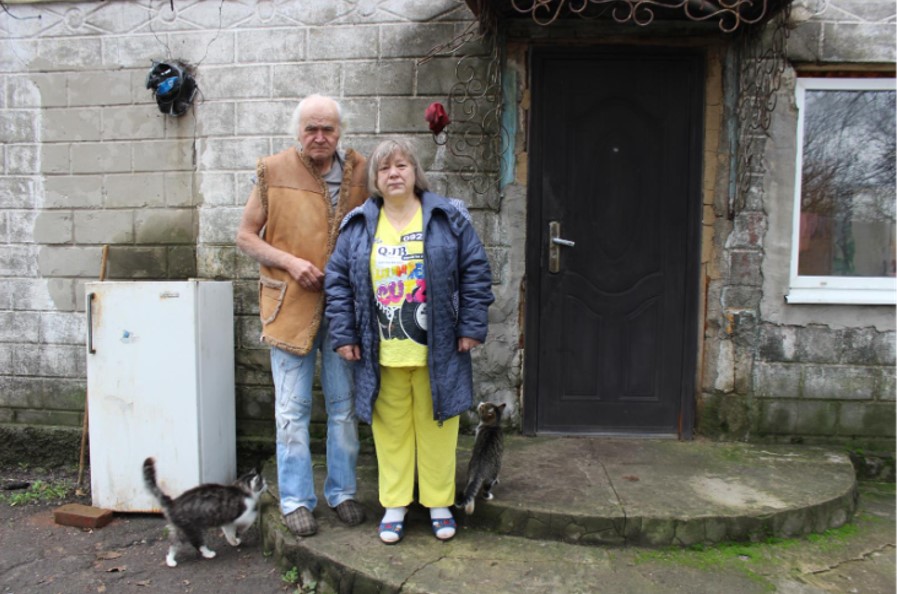
Lyudmyla Brovchenko, 63 years old, lived all her life in the village of Pervomaiske, just 12 kilometres from Donetsk. In 2014, the war began. Her husband was on his way to work, and Lyudmyla went to the train station. There were no buses anymore, and the dispatcher simply said, “war.” Together with her husband and a few women, they walked about 12 kilometres, under the fear of snipers and mines. That was the beginning of her new reality.
In 2015, Lyudmyla suffered a blast injury – “Three shells of 152 mm calibre landed right next to my house. I lost my hearing in one ear”. Roofs and homes in the village were damaged. Later, things calmed down a little, repairs began, and hope returned. But she lived under, a blockade: half a year without water, pensions, or salaries.
By 2022, life became unbearable. Phosphorus munitions fell at night, houses burned, and cluster bombs killed people. “We realized there was no chance to survive and decided to evacuate. We took our dog, our cat, and a few bags and left “into nowhere.”
Lyudmyla arrived in Dnipro. An acquaintance offered us a small house in a village. There was no electricity, and for two months, the couple cooked on an open fire.
Lyudmyla lives with a traumatic brain injury, and every six months she must stay in the hospital - sometimes in Mechnikov, sometimes in other clinics. Without treatment, seizures begin. She even carried syringes with her to inject herself if needed.