WHO Disability Health Equity Network members, participants at the first meeting in Geneva, 12-13 November 2025.
In November 2025, WHO launched the Disability Health Equity Network after years of collective advocacy to advance the right to health for persons with disabilities. HI played a central role in shaping the Network and now co-leads the workstream focused on building a disability-inclusive health sector. Over two inspiring days, WHO brought together a coalition of over 150 organisations to shape a shared vision for advancing health equity for persons with disabilities. In an energising exchange of knowledge, priorities, and vision, partners across the Network shared their expertise and built momentum towards universal health coverage that leaves no one behind.
"We have a human right to healthcare like everyone else. If the 1.3 billion persons with disabilities are excluded there is no chance of achieving universal health coverage and there is no chance of achieving sustainable development." - Janet Charchuk, Down Syndrome International Board member.
Around the world, the 1.3 billion persons with disabilities continue to experience lower quality services or find the health and care they need is inaccessible and unaffordable. According to the WHO’s Global Report on Health Equity for Persons with Disabilities (2022), unfair, unjust and avoidable structural conditions affect persons with disabilities disproportionately and result in poorer health outcomes. The right to health of persons with disabilities is consistently violated, and they often encounter barriers to accessing health services, including physical, communication, attitudinal and institutional barriers and less health coverage, directly leading to worse health outcomes. For example, persons with disabilities are three times more likely to be denied healthcare and four times more likely to be treated badly when accessing services. Per year, more than twice the number of persons with disabilities die than those without disabilities. And this is worse for people with intellectual disabilities, who are eight times more likely to die before reaching 17 years old, and have a 20-year lower life expectancy, compared to people without intellectual disabilities. There is an urgent need for coordinated action and leadership to address these inequities.

Infographic - Health equity for persons with disabilities. Source : World Health Organisation (WHO). 2022
In June 2025, the WHO launched the Disability Health Equity Initiative, which aims to close the avoidable health gaps between persons with disabilities and the broader population. The Initiative will work to progress health equity through four strategic workstreams:
HI is proud to be co-leading Workstream 3 to embed disability inclusion across health systems. As a global leader in inclusive health, HI is aptly placed to be leading this work, and is committed to building equitable, resilient, and sustainable health systems that uphold the right to health for all.
“In the last 10 years, HI has been at the forefront of the major initiatives that promote health equity for persons with disabilities at the global level” says Dr Alessandra Aresu, the Director of Health & Protection at HI.
Through a rights-based, person-centred approach, HI addresses systemic barriers to care and promotes universal health coverage by combining advocacy, technical assistance, and community-based solutions. HI’s work spans inclusive mental health and psychosocial support, equitable access to non-communicable disease prevention and treatment, sexual and reproductive health, early childhood development, and climate-resilient health services.
“It has been an incredible journey, personally and professionally, that culminates in the launch of the WHO Disability Health Equity Network, a platform that acknowledges, elevates, and amplifies the voices of persons with disabilities and long-term committed actors like HI” continues Dr Aresu.
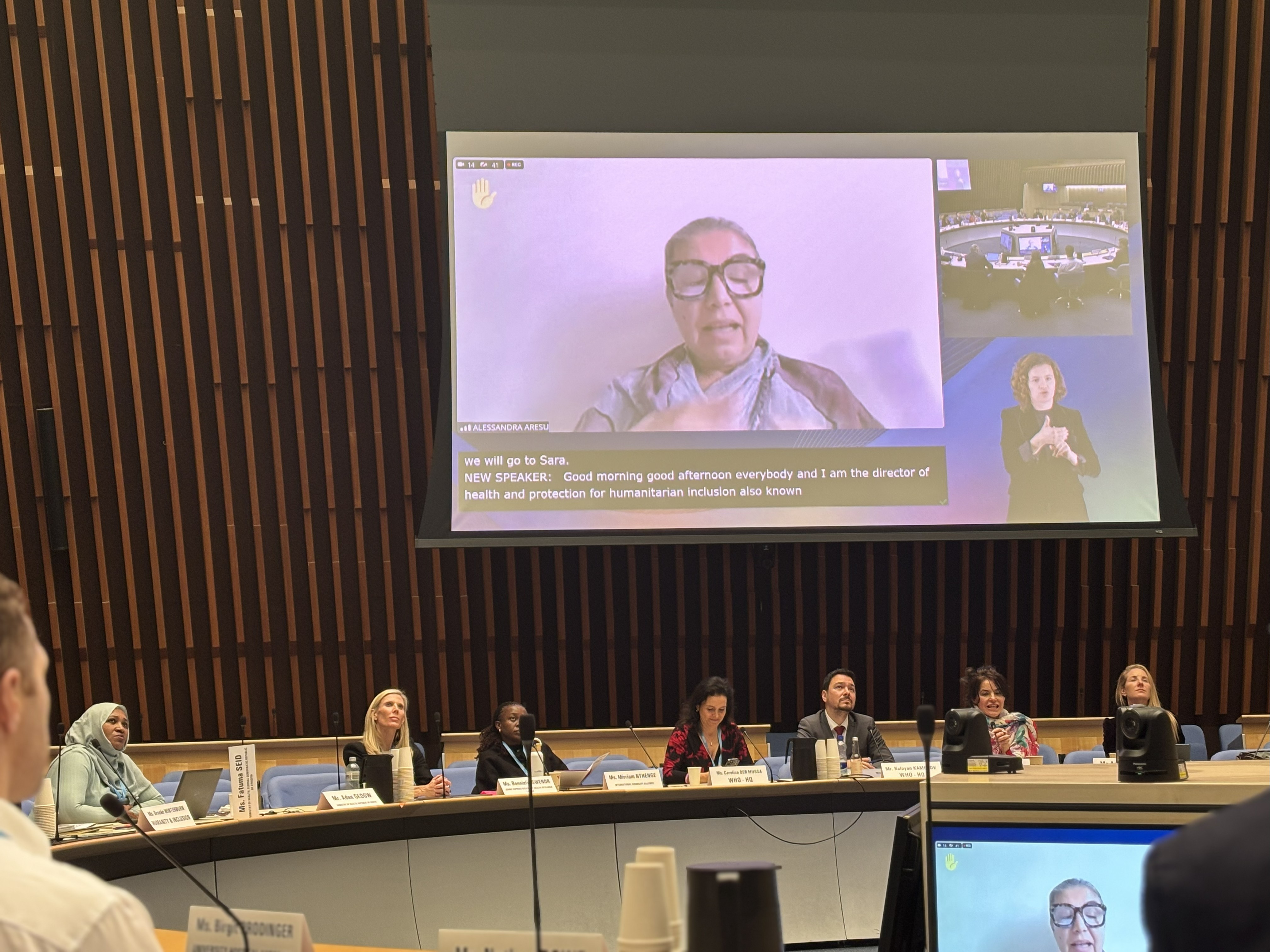
Speech by Alessandra Aresu, Director of Health and Protection division at Handicap International - Humanity & Inclusion
By partnering with governments, health providers, and organisations of persons with disabilities, HI strengthens health systems, advances health equity, and ensures that everyone can access quality care and live with dignity.
“Our significant experience in advancing health systems reform, including supporting implementation of the WHO Health Equity Disability Inclusion Guide for Action with governments in Ethiopia, Nepal, Cambodia, Uganda and Senegal, will be instrumental to this role” explains Dr Aresu.
In addition, HI’s partnership with Down Syndrome International supports Workstream 1 – building leadership on health equity among persons with disabilities. Our recent report on health equity for people with intellectual disabilities, Our Say in Our Health, shares the powerful evidence and lived experiences of healthcare from people with Down syndrome and intellectual disabilities, including the solutions they want to see.
The WHO Disability Health Equity Initiative has gathered a diversity of stakeholders to support the efforts of the four workstreams via this new Network. HI is one of the more than 150 members who have come together to shape a shared vision for advancing health equity for persons with disabilities. Other members include UN agencies, organisations of persons with disabilities (OPDs), civil society organisations, academics, health actors, and ministries from WHO Member States. These include governments of countries such as Uganda and Ethiopia where HI is engaged in inclusive health programming, which reinforces the important role HI can play in supporting ministries of health to advance the health equity agenda.
The Network aims to bring stakeholders engaged in disability and health towards a common understanding and narrative of the evidence-based changes required to achieve universal health coverage, and the highest attainable standard of health for persons with disabilities.
At the launch, the Network established a shared vision for its impact, aligned members on the strategic approach of the Initiative, defined the Network’s pivotal role within the Initiative, and analysed key priorities to inform Workstreams’ workplans.
HI looks forward to continued collaboration with WHO, governments, OPDs and health partners to strengthen health systems that deliver equitable, quality care for all persons with disabilities.
“I would like to leave you with three main messages. First, we need to commit to make healthcare fair for all people, and including people like me. Second, to have effective change, people with disabilities and their organizations need to be involved in information sharing and making decisions. And third, it is not fair hat people with disabilities may have poorer health than others and not live as long. With fair health care, we can be healthier and live longer.” - Pearl Lüthy, a young woman and self-advocate with Down syndrome from Switzerland who shared a video to open the WHO Network launch.