On the 24
th and 25
th, 57 countries, 10 regional organisations and 19 UN agencies came together to participate in the Brussels II Conference ‘Supporting the future of Syria and the region’.[caption id="attachment_3820" align="alignright" width="300"]
Martin Lagneau representing HI, at the Donor Conference "Supporting the future of Syria and the region" in April 2018, Brussels.[/caption]HI was mobilised during those two days, raising awareness of the general public and decision makers outside of the precinct of the conference, but also within its walls. Representatives from the organisation took part to the “Dialogue with NGOs” on the 24
th. HI was also one of the few members of civil society attending the ministerial conference on the 25
th, a new opportunity to convey its main recommendations on the emergency and long-term response to the Syrian crisis.
Financial commitments still insufficient
The conference succeeded in mobilising humanitarian aid to Syrians inside the country and in the neighbouring countries, including for hosting communities, through pledges totalling $ 4.4 billion (€ 3.5 billion) for 2018, as well as multi-year pledges of $ 3.4 billion (€ 2.7 billion) for 2019-2020. Although HI welcomed these pledges, these commitments fail to respond to the unprecedented scale of severity and complexity of the crisis, and to the situation of the millions of Syrians in need of life saving aid and protection.Though the crisis is now in its eighth year, the unmet and growing needs of millions of men, women and children mean that donor countries cannot show any sign of fatigue. This conference did not go nearly far enough to provide adequate legal protection, health services and physical rehabilitation, socio-economic support and education to the 5 millions of Syrian refugees.
Strong messages of support for the protection of Syrian civilians
If financial commitments are disappointing, countries meeting in Brussels still sent a strong message of support by calling for protection of civilians trapped in the conflict and reaffirming that returns of Syrians to and within the country is not possible so long as the conditions for a safe, dignified and voluntary return are not met. The final declaration specifically mentions that the co-chairs “
requested that humanitarian mine action programming be accelerated as a matter of urgency” (read the co-chairs declaration
here).
The international community also stressed the importance of unimpeded and sustained access to civilians inside Syria, which is central to any effective delivery of life-saving aid and to continuity of services and enhanced protection (read
here the annex Inside of Syria).
Refugees’access to health care in host communities in neighbouring countries was also mentioned as a crucial issue and HI welcomes the commitment of the “
GoJ and international community to review health system approaches and develop a long-term strategy and costed action plan that is sufficiently supported. This will afford Syrian refugees equitable access to national health care systems and provide life-saving interventions to all” (read
here the annex on Jordan).
Stop Bombing Civilians
While HI was in the same moment calling the general public to
sign the petition to stop the bombing of civilians, we particularly welcomed the important declarations of UN officials in:
- the opening remarks of the Under-Secretary General for Humanitarian affairs and emergency relief coordinator, Mark Lowcock:
‘What ordinary Syrians want is for people to stop dropping bombs on them, to stop shelling them and to stop shooting at them. For countless Syrian children, these atrocities are the only things they have known in life. That has to stop.’[…]‘We need to scale up risk education, awareness, and survey work to protect people from the unexploded remnants of war.’
- the statement of the UN humanitarian regional coordinator, Panos Moumtzis:
“High numbers of civilians continue to be killed and injured by air and ground-based strikes and shellings, including the use of explosive weapons in urban areas. The reported targeting of hospitals; attacks on schools and markets; forced displacement; gender-based violence; child recruitment; restricted freedom of movement - are all unacceptable.”
See all the official outcome documents of the conference, joint declaration and annexes:http://www.consilium.europa.eu/en/meetings/international-ministerial-meetings/2018/04/24-25/

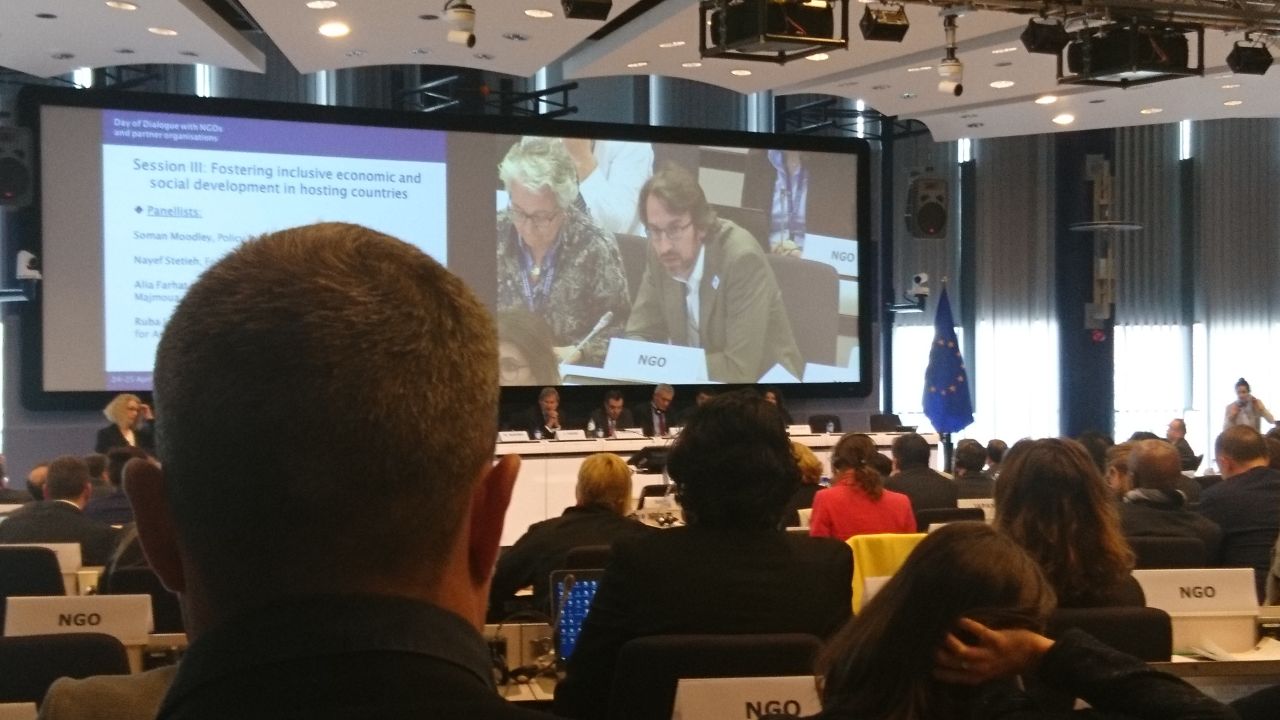 Martin Lagneau representing HI, at the Donor Conference "Supporting the future of Syria and the region" in April 2018, Brussels.[/caption]HI was mobilised during those two days, raising awareness of the general public and decision makers outside of the precinct of the conference, but also within its walls. Representatives from the organisation took part to the “Dialogue with NGOs” on the 24th. HI was also one of the few members of civil society attending the ministerial conference on the 25th, a new opportunity to convey its main recommendations on the emergency and long-term response to the Syrian crisis.