Quality inclusive education (IE) is a fundamental part of the new Sustainable Development Goal agenda.This is the clear message of
two new posters recently published by the Inclusive Education Task Group, as part of the International Disability and Development Consortium (IDDC).
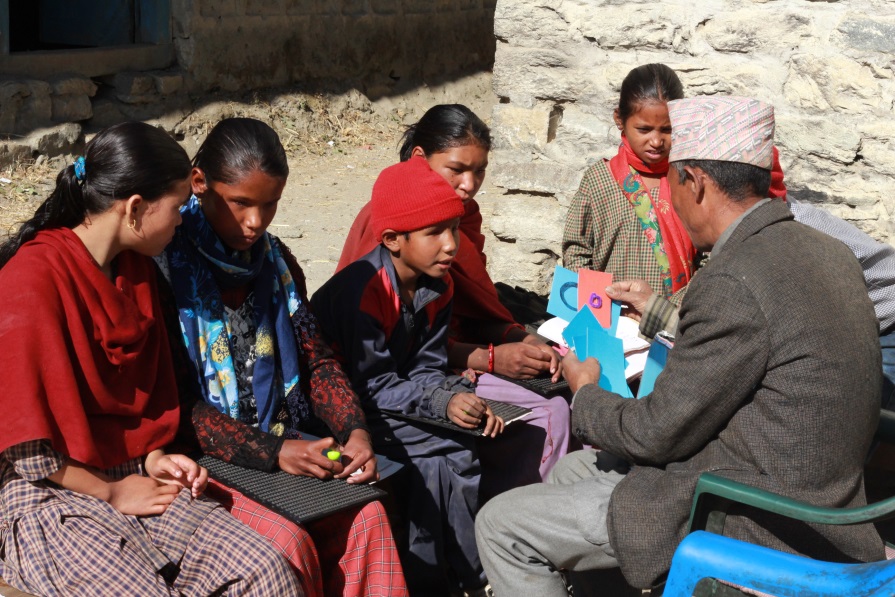
[caption id="attachment_2313" align="alignright" width="300"]
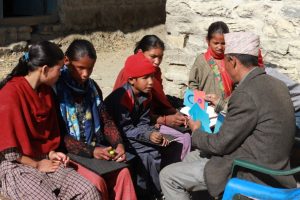
©Julia McGeown, Handicap International[/caption]The IDDC is a global consortium of disability and development non-governmental organizations (NGOs), mainstream development NGOsand disabled people's organisations (DPOs) supporting disability and development work in more than 100 countries around the world.The posters have been published to coincide with the launch of a new report
#costingequity looking at equitable financing for disability-inclusive education. The report examines some of the main challenges facing governments and the global education community to make SDG 4 a reality.
We think it’s important to share simple visual messages about how to action SDG 4 on the ground, and also how IE interlinks with the other SDGs.
Poster 1: Inclusive Education as a cross-cutting issue:
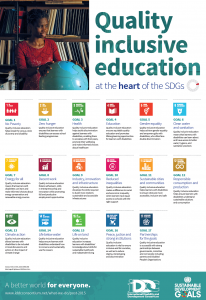
The poster details the importance of quality inclusive education, particularly for children with disabilities, in all of the 17 SDGs. The purpose of the poster is to demonstrate how inclusive education underpins many of the other goals, and that without quality inclusive education, the success of these goals will be limited.For example, quality inclusive education helps break the vicious cycle of poverty and disability, working towards goal 1. Another example is Goal 5 on gender equality, since quality inclusive education helps to achieve gender equality and empower girls with disabilities who often face a double discrimination.Quality inclusive education also fosters self-esteem, skills in entrepreneurship and innovation while promoting full and productive employment opportunities for all, including learners with disabilities. This specifically targets Goal 8, on “decent work and economic growth”. Further linkages are highlighted in the poster and this should help to highlight the crucial importance of inclusive education as a cross cutting issue in development.
Poster 2 :Implementing SDG 4 for learners with disabilities
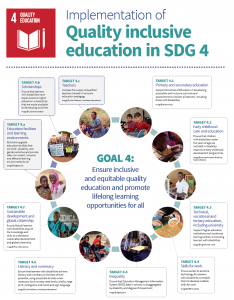
The second poster gives concrete actions that can be taken by schools or at the system level to implement the different targets of SDG 4, with a special focus on learners with disabilities. The purpose of the poster is to enable a wide variety of stakeholders to understand how to relate SDG 4 to their own situation, and take action.Some targets already have specific goals such as Target 4.a on education facilities and learning environments:
“Build and upgrade education facilities that are child, disability and gender sensitive and provide safe non-violent inclusive and effective learning environments for all.” However other targets are more general, so the aim of the poster is to break this down to concrete actions for this specific target group. For example, for target 4.4. on “skills for work,” the suggestions is to ensure access to assistive technology for learners with disabilities to enable them to develop suitable skills for work. If this is not available, then low-cost alternatives could be investigated while imultaneously lobbying for greater funds or the redirection of funds to this area.Similarly, for target 4.6 on “literacy and numeracy”, learners with disabilities should be encouraged to develop literacy and numeracy to the best of their potential by having access to accessible formats such as easy-read books and pictograms ( for students with learning difficulties who are visual learners), braille, large print, and sign language.At system level, to tackle target 4.5 on inequality, a key action is to ensure the education management information systems (EMIS) data in schools is disaggregated by disability type and degree of impairment and not just by gender. Without this kind of data, there is no way to track whether children with disabilities are being excluded or not, and whether they are remaining in school even if they enroll initially.
Who are the posters for ?
The primary aim of these posters is for distribution at national level not just within the country offices of our NGOs, but also with partner organizations, local civil society organizations, DPOs, education networks, education authorities, and even schools and colleges.
How can they be used ?
Ideally we would also hope to use these posters as part of advocacy efforts towards local and national governments, and we would encourage anyone who has links with ministries of education, social welfare, finance or other associated ministries to use them as advocacy tools.We hope that the posters help to kick-start awareness of the crucial importance of inclusive education and how to tackle this at a practical level. We know that half of the world’s 65 million school aged children with disabilities are out of school.The time for a revolution in inclusive education is now.
 Author:
Julia McGeown is Inclusive Education Technical Advisor at Handicap International. She is also a member of the Inclusive Education Task Group of IDDC.

 ©Julia McGeown, Handicap International[/caption]The IDDC is a global consortium of disability and development non-governmental organizations (NGOs), mainstream development NGOsand disabled people's organisations (DPOs) supporting disability and development work in more than 100 countries around the world.The posters have been published to coincide with the launch of a new report #costingequity looking at equitable financing for disability-inclusive education. The report examines some of the main challenges facing governments and the global education community to make SDG 4 a reality.
We think it’s important to share simple visual messages about how to action SDG 4 on the ground, and also how IE interlinks with the other SDGs.
©Julia McGeown, Handicap International[/caption]The IDDC is a global consortium of disability and development non-governmental organizations (NGOs), mainstream development NGOsand disabled people's organisations (DPOs) supporting disability and development work in more than 100 countries around the world.The posters have been published to coincide with the launch of a new report #costingequity looking at equitable financing for disability-inclusive education. The report examines some of the main challenges facing governments and the global education community to make SDG 4 a reality.
We think it’s important to share simple visual messages about how to action SDG 4 on the ground, and also how IE interlinks with the other SDGs.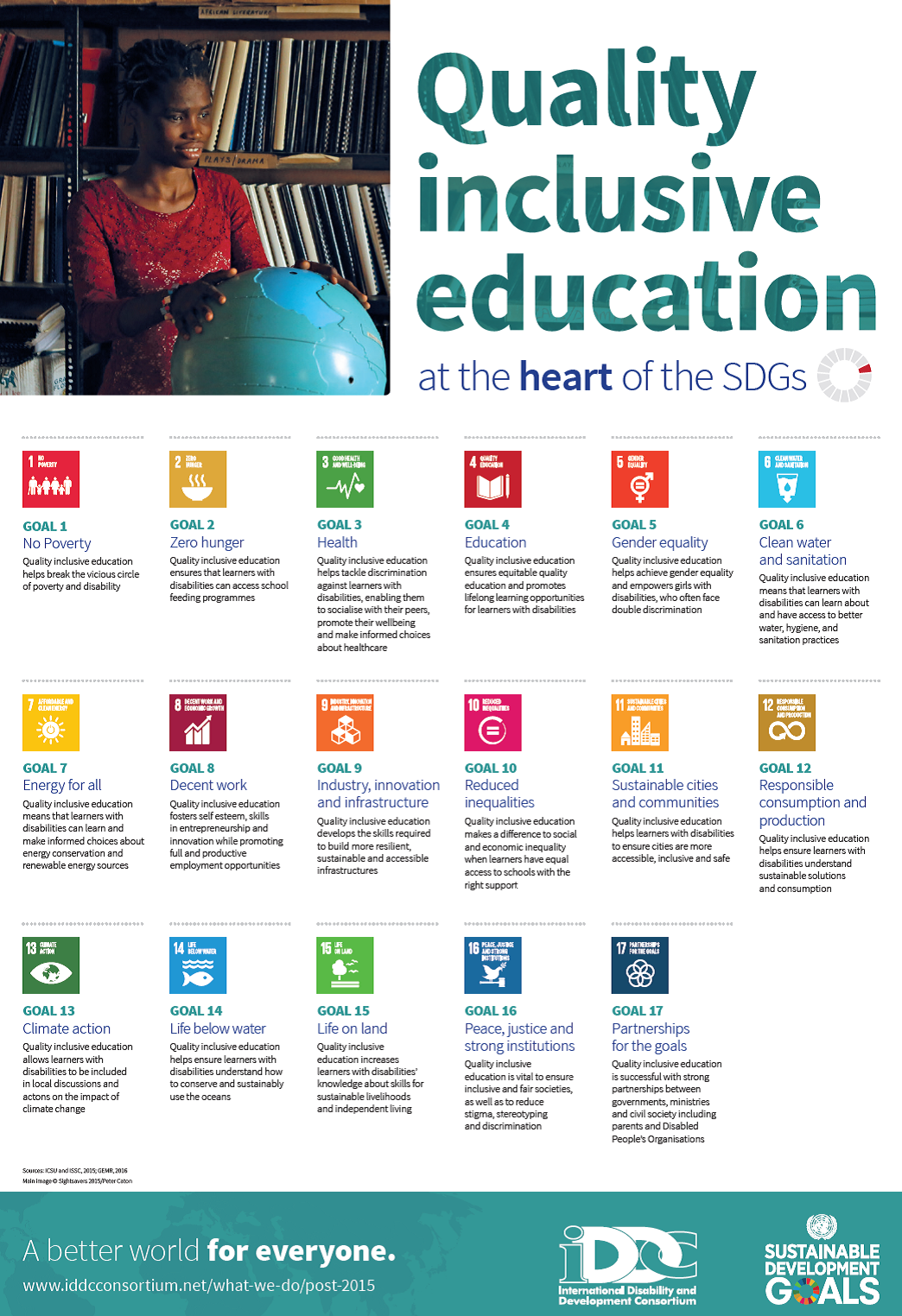 The poster details the importance of quality inclusive education, particularly for children with disabilities, in all of the 17 SDGs. The purpose of the poster is to demonstrate how inclusive education underpins many of the other goals, and that without quality inclusive education, the success of these goals will be limited.For example, quality inclusive education helps break the vicious cycle of poverty and disability, working towards goal 1. Another example is Goal 5 on gender equality, since quality inclusive education helps to achieve gender equality and empower girls with disabilities who often face a double discrimination.Quality inclusive education also fosters self-esteem, skills in entrepreneurship and innovation while promoting full and productive employment opportunities for all, including learners with disabilities. This specifically targets Goal 8, on “decent work and economic growth”. Further linkages are highlighted in the poster and this should help to highlight the crucial importance of inclusive education as a cross cutting issue in development.
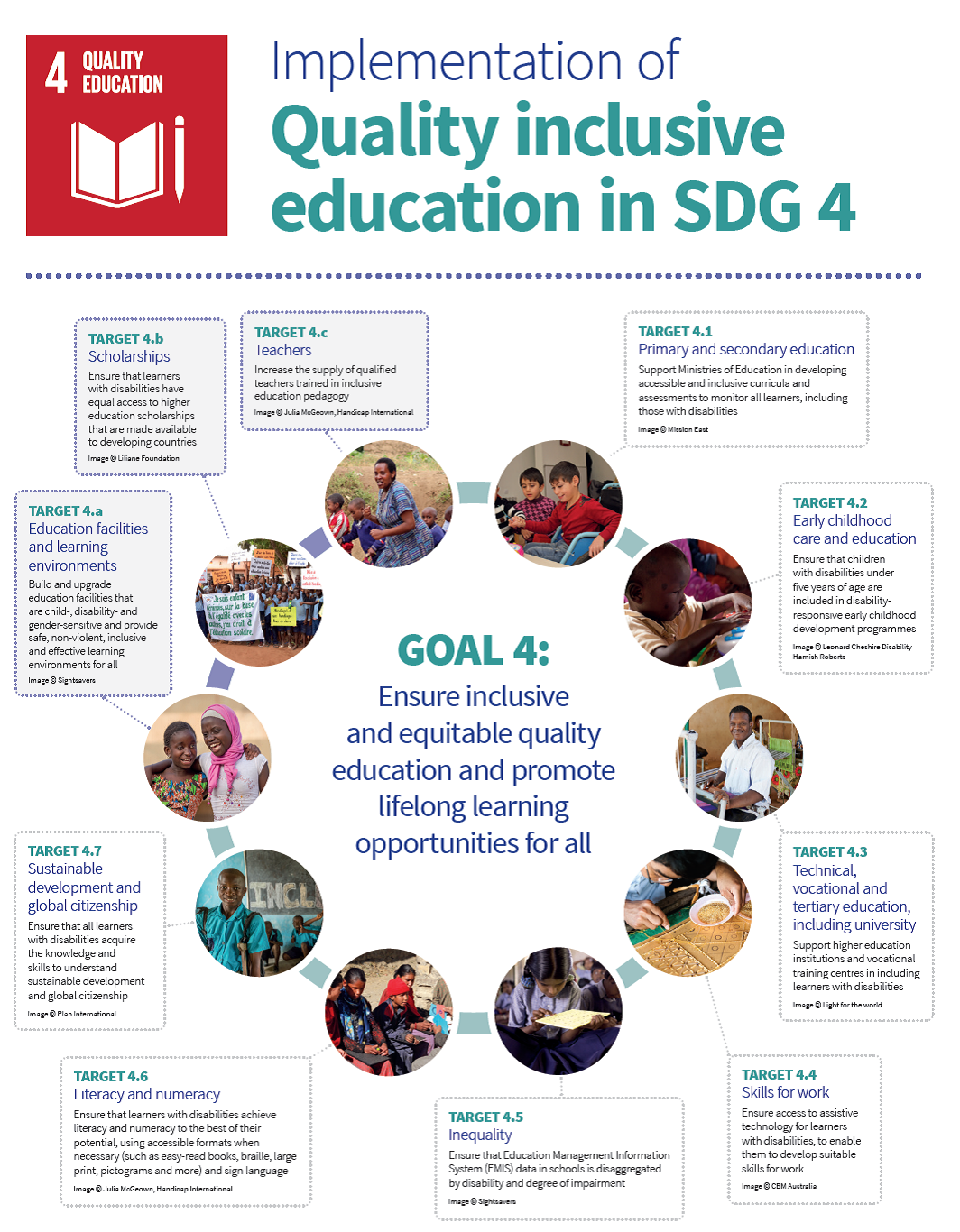 The second poster gives concrete actions that can be taken by schools or at the system level to implement the different targets of SDG 4, with a special focus on learners with disabilities. The purpose of the poster is to enable a wide variety of stakeholders to understand how to relate SDG 4 to their own situation, and take action.Some targets already have specific goals such as Target 4.a on education facilities and learning environments: “Build and upgrade education facilities that are child, disability and gender sensitive and provide safe non-violent inclusive and effective learning environments for all.” However other targets are more general, so the aim of the poster is to break this down to concrete actions for this specific target group. For example, for target 4.4. on “skills for work,” the suggestions is to ensure access to assistive technology for learners with disabilities to enable them to develop suitable skills for work. If this is not available, then low-cost alternatives could be investigated while imultaneously lobbying for greater funds or the redirection of funds to this area.Similarly, for target 4.6 on “literacy and numeracy”, learners with disabilities should be encouraged to develop literacy and numeracy to the best of their potential by having access to accessible formats such as easy-read books and pictograms ( for students with learning difficulties who are visual learners), braille, large print, and sign language.At system level, to tackle target 4.5 on inequality, a key action is to ensure the education management information systems (EMIS) data in schools is disaggregated by disability type and degree of impairment and not just by gender. Without this kind of data, there is no way to track whether children with disabilities are being excluded or not, and whether they are remaining in school even if they enroll initially.
 Author:Julia McGeown is Inclusive Education Technical Advisor at Handicap International. She is also a member of the Inclusive Education Task Group of IDDC.